Open and Collaborative Review
One particularity of « La Revue LEeE » is to propose an Open and Collaborative Review process (OCR), in line with a formative approach to scientific knowledge construction.
The intent is to initiate new collaborative peer review practices, using digital tools to bring forth dialogue and negotiation processes on a given text.
The purpose of this peer review process is to add to the understanding and clarification of the feedback addressed to the author(s), to encourage the construction of shared meaning regarding the scientific project of the contribution (including through debates and controversies).
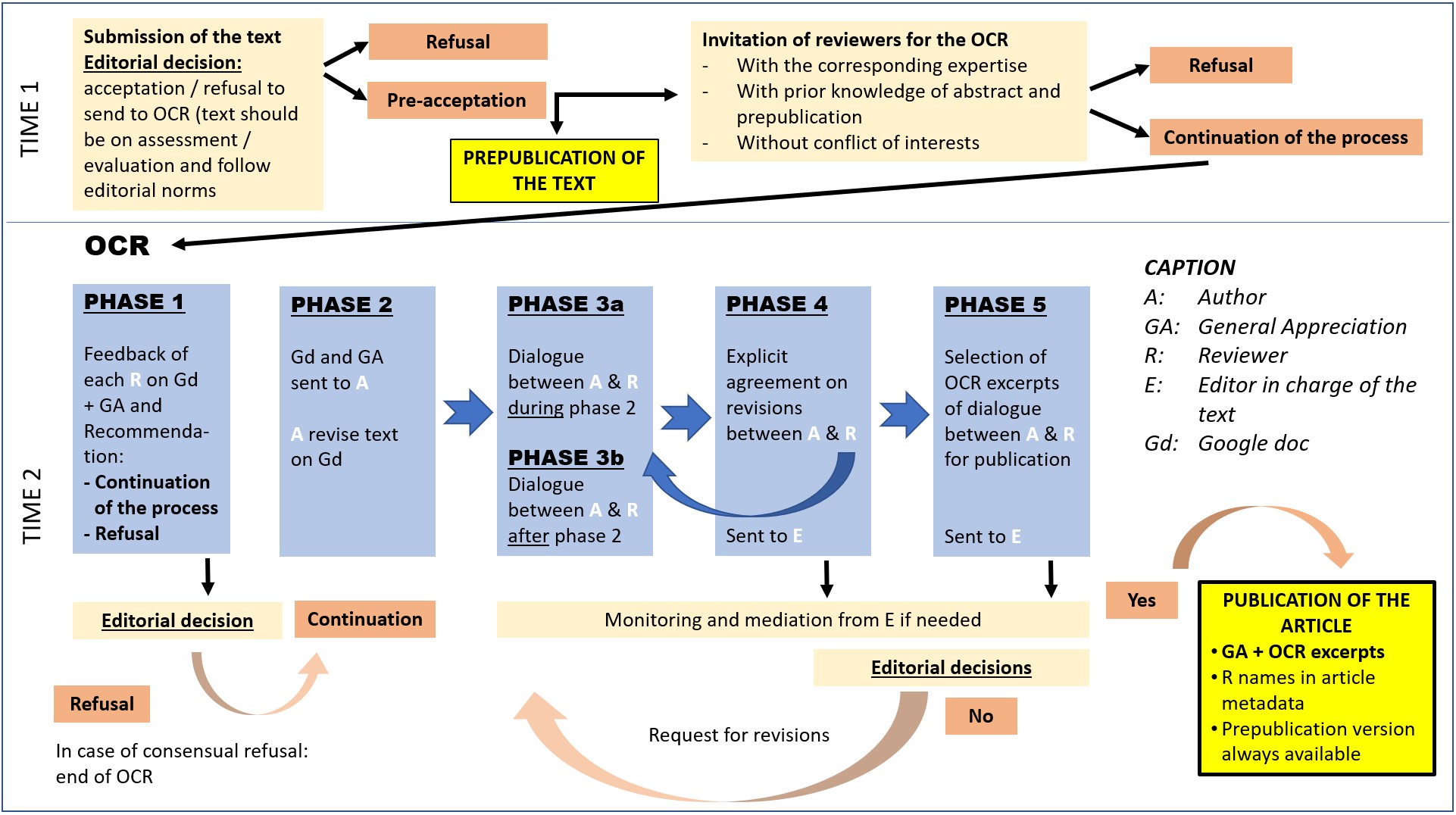
Mapping of the Open and Collaborative Review process (OCR) of the journal
What should you know?
Before the OCR, as soon as submitted:
- The test is pre-reviewed by the editorial committee with the following criteria:
(1) the text follows the editorial norms of La Revue LEeE.
(2) the text is about assessment in education and training.
(3) the text matches one of the text types that is published by La Revue LEeE.
(4) the version of the text meets sufficient scientific quality, allowing its prepublication and submission to reviewers. - If it is pre-accepterd, the text is prepublished online. This editorial choice aims to promote a quick access to the work of the scientific community. The prepublication version explicitly indicates that the text has not been peer-reviewed yet.
- Being prepublished does not guarantee the final publication of the text, which depends upon the acceptation of the peer reviewers and of the editorial team.
During the OCR:
- The identities of the authors and the reviewers are known. Both sides are formally informed at the beginning of the process.
- First, feedback is provided by commenting on the text submitted on an online platform (Google docs) based on review criteria. Reviewers interact on the same document.
- In a second phase, the review consists in discussing with the author(s) on the Google doc if necessary. A discussion space is also provided for dialogue on the journal platform.
- Authors and reviewers share responsibility for the completion of the review.
- The editor makes the final decision on the publication.
After the OCR, when the text is accepted and published:
- Reviewers' names appear in the metadata of the published article.
- The prepublished version and its date always stay available for consultation.
- Reviewers’ general appreciations are published in appendix.
- With prior agreement of authors and reviewers, comments associated with excerpts of the text may be published in order to provide readers with an opportunity to see controversies and formative dialogue.
More generally, the goal is to strive towards the publication of « enhanced » texts, with the publication of resources / documents associated to the texts.
For more information on the OCR process and its analysis: https://revue.leee.online/index.php/info/article/view/96
The open and collaborative peer review process has the following purposes :
- a greater transparency of review and revision processes, with a greater co-responsibility between authors and reviewers (and editors),
- not only to improve the quality of the written content, but also to consider processes as professional development opportunities for everyone,
- with relationships between actors that are more symetrical and collaborative, encouraging the feeling of participation in a common project.
 © 2018 LEeE.online